|
|
 |
In order to help you with your selection, we have created a "how
to measure" section below
| How to Measure | | Measuring Tips | - Use a metal measuring tape. (Flexible cloth tapes are not as
accurate, as they may stretch.)
- Record measurements clearly. Indicate which measurement is the
width, and which is the height. It’s a common mistake to switch the
two measurements.
- Be precise. Round measurements to the nearest one-eighth (1/8)
of an inch.
- Measure for width in three different places: at the top,
the middle, and the bottom of the window. For an inside
mount, use the shortest width. For an outside mount,
consider how far you’d like the treatment to extend beyond the
window frame on each side.
- Measure for length in three different places: from the
top right, top left, and top center of the window to the desired
length. Use the longest measurement, except when measuring for
vertical blinds.
- Don’t be surprised if your window is out-of-square. It probably
isn’t noticeable if it is off a little. However, if there is a
considerable difference, you may want to use an outside mount to
hide the imperfection.
|
- Printable worksheets are available to help guide you through
the process, while providing a place to note measurements. Look
forprint my measurement worksheet within the measuring
directions for the type of window treatment you’d like to purchase.
|
|  pleated shades | | |  roman shades |
| |  curtains |  draperies |
| | Note: The headrail protects the mechanism
that raises and lowers the blind or shade.For inside mount installation: Width: Measure (A) where headrail or roller will be
installed. Length: Measure (B) from top on inside casing to
windowsill. |  | Before ordering, see product depth
information below.For outside mount installation: Width: Measure (C) where headrail will be installed. For
horizontal blinds and pleated shades, the headrail must overlap
window 1 1/2 inch or more on each side; for Roman and roll up
shades allow at least 2 inches on each side. Length: Measure (D) where top of headrail will be installed
to the windowsill or floor. |  | Patio door horizontal blinds include two
separate headrails and are always mounted outside the window
casing. | | Product Depth for Horizontal Blinds, Pleated, Roll Up, Cellular, and Roman Shades For inside mounts: Product depth refers to how far your blind
or shade’s headrail will project out from the mounting surface when
inside mounted. This is useful to know if you are mounting your
blind or shade under another treatment like a cornice or panels
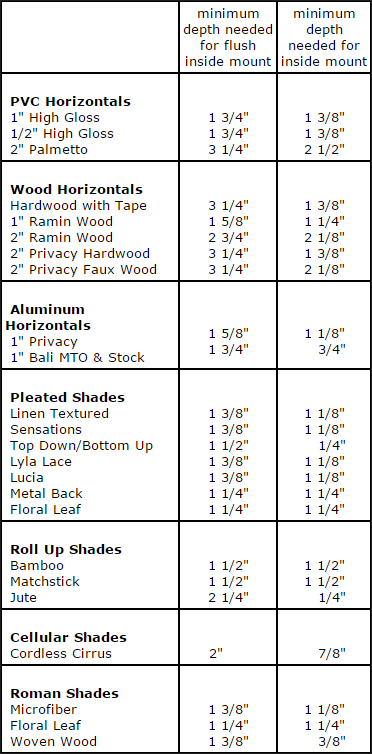
and, it gives a neat, finished appearance to your window. Check the table below to verify that your
window opening is deep enough to fit the blind or shade you’ve
chosen. The table lists two depths: the minimum needed for an
inside mount, and the minimum needed to flush mount your blind or
shade (i.e. fully recess it in the window so it will not project
out of the opening). | | | minimum depth needed for
flush inside mount | minimum depth needed for
inside mount | PVC Horizontals 1" High Gloss 1/2" High Gloss 2" Palmetto |
1 3/4" 1 3/4" 3 1/4" |
1 3/8" 1 3/8" 2 1/2" | Wood Horizontals Hardwood with Tape 1" Ramin Wood 2" Ramin Wood 2" Privacy Hardwood 2" Privacy Faux Wood |
3 1/4" 1 5/8" 2 3/4" 3 1/4" 3 1/4" |
1 3/8" 1 1/4" 2 1/8" 1 3/8" 2 1/8" | Aluminum Horizontals 1" Privacy 1" Bali MTO & Stock |
1 5/8" 1 3/4" |
1 1/8" 3/4" | Pleated Shades Linen Textured Sensations Top Down/Bottom Up Lyla Lace Lucia Metal Back Floral Leaf |
1 3/8" 1 3/8" 1 1/2" 1 3/8" 1 3/8" 1 1/4" 1 1/4" |
1 1/8" 1 1/8" 1/4" 1 1/8" 1 1/8" 1 1/4" 1 1/4" | Roll Up Shades Bamboo Matchstick Jute |
1 1/2" 1 1/2" 2 1/4" |
1 1/2" 1 1/2" 1/4" | Cellular Shades Cordless Cirrus |
2" |
7/8" | Roman Shades Microfiber Floral Leaf Woven Wood |
1 3/8" 1 1/4" 1 3/8" |
1 1/8" 1 1/4" 3/8" |
|
| | | | Measuring for- |  vertical blinds | | Outside mount installation
only: A headrail is installed and
vanes are attached. Width: Measure (A) where headrail will be installed.
Headrail must overlap window or door opening at least 3
inches on each side for proper stacking of vanes when blinds
are open. Length: Measure (B) where top of headrail will be installed
to the windowsill or floor. | |
| | | | Measuring for- |  cut-to-width roller shades | | These shades are cut-to-width and shipped directly from our
distribution centers. Roller shades have slightly larger light gaps on the sides
than other products. If you need maximum light control and privacy,
consider an outside mount. | To order,
please include: - catalog number
- exact width (see measuring instructions below)
- color code and name
To replace old shades that
fit: Measure old roller from end to end, including metal tips. Order
that width. For new shades:Decide if you will install shade inside or outside window casing. Please note:The roller for shades is held in place by brackets and the shade
fabric is 1/2 to 1 inch narrower than the roller. For inside mount installation: Width: Measure (A) where
brackets will be installed and subtract 1/8 inch from total
measurement and order that width. Measure each window
separately—widths may vary slightly. Length: Measure (B) from top
of inside casing to windowsill. (Shades fit windows up to 66
inches long.) | | For outside mount installation: Width: Measure (C) where
brackets will be installed. Shade should overlap window at least 1
1/2 inches on each side for maximum light control. Length: Measure (D) from top
of casing to windowsill. (Shades fit windows up to
66 inches long.) | handbook. | To adjust spring tension after installation, please see instruction
handbook. |
| | | | Measuring for- |  curtains draperies | | Determine Rod Width Center-draw draperies: Measure the window width (A). If you already own the traverse rod
you intend to use, measure the rod return (the measurement from the
face of the rod to the wall). If you don’t already have a traverse
rod, consider the return to be 4 inches for measuring
purposes. To determine width: Add window width, right and left returns, and a 4 inches for
overlap at the center. If you intend to open and close your
draperies for privacy and/or light control, the rod should be
approximately 15% wider than the window. This will allow the
draperies to stackback against the wall and leave space for panels
to clear glass when open. For one-way-draw draperies: Add rod return for just one side, plus 1 inch for drapery to
extend past the rod. Total of rod width, returns, and overlap is your total
Rod Width. Example: | | Window Width = | 34" | | Right Return = | 4" | | Left Return = | 4" | | Center Overlap = | + 4" | |
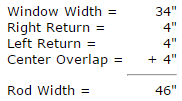
| | Rod Width = | 46" |
Determine Curtain/Drapery
WidthOnce you have determined total Rod Width, use the chart below to
determine the proper Drapery Width to order. If Total Rod Width Is | Order Drapery Width | Pleats Per Pair | Hooks Required, Per Pair | | 40 to 48" | 48 to 50" | 10" | 14" | | 49 to 72" | 72 to 75" | 14" | 18" | | 73 to 96" | 96 to 100" | 20" | 24" | | 97 to 120" | 120 to 125" | 26" | 30" | | 121 to 144" | 144 to 150" | 30" | 34" |

Determine Curtain/Drapery Length The rod should be positioned at least 4 inches above window so
pleats are not seen from the outside. Measure for length from where
the top of the rod will be positioned to the desired length. Most
common lengths are to the windowsill (B), just below the window
trim or apron (C), or to the floor (D). If using a decorative
traverse rod or pole with rings, measure from the eye of the
carrier or ring to the sill, apron or floor. - Window width: Measure width including window casing, if any.
- Length to windowsill: Subtract 1/2 inch for clearance.
- Length to apron.
- Length to floor: Subtract 1/2 inch for clearance.

Allow for StackbackStackback is the amount of space
needed on either side of the window if pinch pleated draperies are
to clear the glass when they are opened all the way. With one-way
draw treatments, panels are stacked to one side and the measurement
is taken completely from that side of the window. As a general
rule, add 15% to your window width to allow for stackback. 
Rod Pocket Curtains,
Pole Top Draperies and Top TreatmentsDetermine Width Measure the area to be covered (A). Unless instructed otherwise in item description, order 2 1/2
to 3 times the width measured to achieve a full, custom look. Determine LengthMeasure where you want your window coverings to fall. Measure from
top of the rod to the windowsill (B), apron (C), or floor (D).
Allow 1/2 inch for floor or windowsill clearance (the measurement
from the back of the rod to the wall). Please note header size (the part of the curtain that is above
the rod pocket) and whether it is included in the stated lengths. - Window width: Measure width including window casing, if any.
- Length to windowsill: Subtract 1/2 inch for clearance.
- Length to apron.
- Length to floor: Subtract 1/2 inch for clearance.

|
|
|
 |
|
|
|
 |
 |
 |
|